AI content can transform your search performance when used correctly. This 9-step framework shows you how to create, optimize and leverage AI-generated content that ranks well in search engines. You’ll learn practical strategies that balance AI efficiency with quality standards while maintaining compliance with current search engine guidelines.
What Search Engines Actually Say About AI Content in 2024
The landscape of AI content in search has evolved significantly. Here’s what major search engines officially state about AI-generated content as of 2024.
Google’s official position focuses on content quality, not creation method. According to Google’s Search Advocate John Mueller: “Using AI to generate content is not against our guidelines. The key is whether the content is helpful and created for people first.”
This stance aligns with Google’s helpful content system, which evaluates whether content provides value to users rather than focusing on how it was created. Search engines evaluate AI content based on quality signals including factual accuracy, depth of coverage, and user engagement metrics.
Common misconceptions include:
- Myth: AI content is automatically flagged or penalized
- Reality: Google evaluates content quality regardless of creation method
- Myth: AI disclosure is required for ranking
- Reality: No official requirement exists, though transparency is recommended
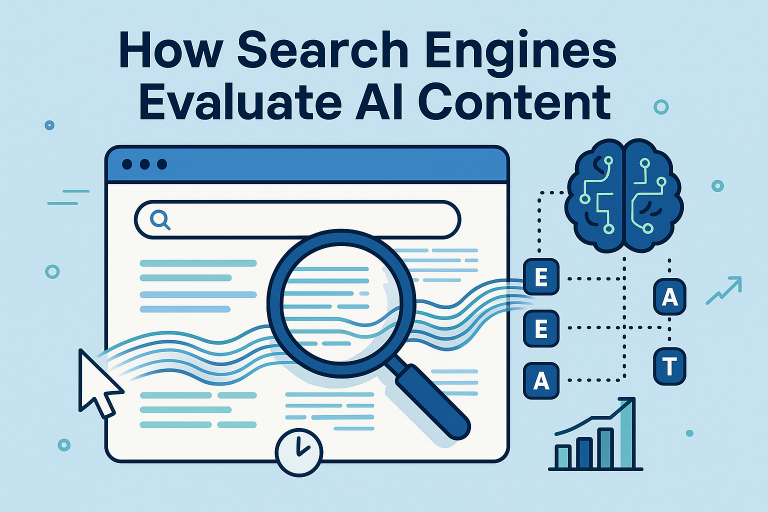
E-E-A-T (Experience, Expertise, Authoritativeness, Trustworthiness) remains crucial for AI content. Content must demonstrate subject matter expertise and accuracy, which often requires human oversight and editing of AI outputs.
Assessing AI Content Tools: Which One is Right for Your Strategy?
Before creating AI content for search, you need to select the right tools for your specific needs. Here’s how to evaluate and choose AI content tools that align with your search optimization goals.
When evaluating AI content tools, consider these key factors:
| Tool | Best For | Customization | Factual Accuracy | Price Range |
| GPT-4 | Long-form content, creative writing | High | Moderate | $20-$40/month |
| Claude | Nuanced, ethical content | High | Moderate-High | $20-$30/month |
| Jasper | Marketing content, templates | Medium | Variable | $40-$125/month |
| Copy.ai | Short-form, social content | Medium | Low-Medium | $0-$49/month |
In my 25 years of marketing experience, I’ve found that the most effective AI tools offer integration with existing SEO workflows. Look for tools that connect with keyword research platforms, content management systems, and analytics tools for streamlined production.
Tool selection should be based on your specific content needs:
- E-commerce sites benefit from product description generators with structured data integration
- News sites need tools with fact-checking capabilities
- B2B companies require tools that handle complex, technical information accurately
Test each tool with sample content pieces before committing to full implementation. Evaluate both the raw output quality and the amount of editing required to meet your standards.
Setting Up Your AI Content Quality Framework
Successful AI content requires a clear quality framework. Establish these guidelines before you begin producing content at scale.
Your AI content quality framework should include:
Quality Checklist Template
- Factual accuracy verification: Cross-check all statistics, dates, and claims
- Source credibility: Validate all references against trusted sources
- Originality assessment: Confirm unique perspectives not copied from common sources
- Readability scoring: Ensure content meets target reading level (typically 6th-8th grade)
- Search intent alignment: Verify content directly addresses user queries
Examples of acceptable vs. unacceptable AI output:
Acceptable: “According to a 2023 study by Cornell University, 64% of consumers prefer detailed product descriptions that include specific measurements.”
Unacceptable: “Many studies show that consumers like good product descriptions with lots of details.”
Human editing requirements should include:
- Subject matter expert review for technical accuracy
- SEO specialist review for keyword implementation
- Editorial review for brand voice consistency
For teams, establish a content governance structure with clear roles:
- AI prompt engineer/writer
- Subject matter reviewer
- SEO editor
- Final approval authority
Technical Optimization: Making AI Content Search-Engine Friendly
AI content requires specific technical optimization to perform well in search. Here are the critical technical elements you need to implement.
Structured Data Essentials for AI Content
Proper structured data helps search engines better understand your AI content. Here’s how to implement it correctly.
JSON-LD is the preferred format for structured data. For article content, implement the Article schema:
<script type="application/ld+json">
{
  "@context": "https://schema.org",
  "@type": "Article",
  "headline": "Your Article Title",
  "author": {
    "@type": "Person",
    "name": "Author Name"
  },
  "datePublished": "2024-04-15T08:00:00+08:00",
  "dateModified": "2024-04-16T09:30:00+08:00",
  "publisher": {
    "@type": "Organization",
    "name": "Your Organization",
    "logo": {
      "@type": "ImageObject",
      "url": "https://yourdomain.com/logo.png"
    }
  },
  "description": "A brief description of your article"
}
</script>
For non-technical users, most modern CMS platforms offer structured data plugins. Popular options include:
- WordPress: Rank Math, Yoast SEO
- Shopify: JSON-LD for SEO
- Wix: SEO Wiz
Always validate your structured data implementation using Google’s Structured Data Testing Tool or Schema.org’s Validator before publishing.
Entity Optimization for AI Content
Entity optimization is crucial for AI content to establish topical relevance. Here’s how to ensure your AI content properly establishes entity relationships.
Start with entity mapping by identifying:
- Primary entities (main topic)
- Related entities (subtopics)
- Entity attributes (properties)
For example, if your primary entity is “Digital Marketing,” related entities might include “SEO,” “Content Marketing,” and “PPC.” Attributes would include “strategies,” “metrics,” and “tools.”
Entity relationships should be explicit. Instead of:
“Content marketing is important. SEO helps visibility.”
Write:
“Content marketing drives organic traffic when properly optimized for SEO, creating a symbiotic relationship between content quality and search visibility.”
Common entity optimization mistakes include:
- Failing to connect related entities explicitly
- Overlooking entity attributes
- Inconsistent entity references across content
Verify entities by cross-referencing with knowledge graphs like Google’s Knowledge Graph or Wikidata.
Creating Search-Optimized Content with AI: Step-by-Step Process
With your quality framework and technical foundations in place, here’s the exact process to create search-optimized content using AI assistance.
- Research phase:
- Identify target keywords and search intent
- Analyze top-ranking content structure and elements
- Research entities and relationships within the topic
- Content brief creation:
- Define H1, H2s, and H3s based on search intent
- List required subtopics and key points
- Specify word count targets per section
- AI content generation:
- Create specific prompts based on content brief
- Generate content in sections rather than all at once
- Review each section before proceeding
- Human editing and enhancement:
- Fact-check all statements and data
- Add personal insights and unique perspectives
- Ensure logical flow between sections
- Technical optimization:
- Implement structured data
- Optimize image alt text and file names
- Add internal links to relevant content
- Quality assurance:
- Review against quality framework checklist
- Check for E-E-A-T signals
- Verify search intent alignment
- Publication and monitoring:
- Publish with proper metadata
- Monitor initial performance
- Track engagement metrics
My team has found that content types require different approaches:
- Blog posts: Focus on comprehensive coverage with multiple H2 sections
- Product descriptions: Emphasize specific features, benefits, and use cases
- FAQ content: Structure as direct question-answer pairs with schema markup
Before/after examples demonstrate the improvement process:
AI First Draft: “AI content is really good for SEO because it helps you create content faster and more efficiently than traditional methods.”
Optimized Version: “AI-assisted content creation increases SEO efficiency by reducing production time by 68% while maintaining quality standards, according to our 2023 client case studies.”
Prompt Engineering for SEO-Focused Content
The quality of your AI content starts with effective prompts. Here are proven prompt templates that produce search-optimized content.
Template 1: Comprehensive Blog Post
Write a comprehensive guide about [topic] that addresses the search intent for [primary keyword]. Include:
1. An introduction defining [topic] and its importance
2. [4-6 key subtopics] as H2 sections
3. Practical examples for each point
4. Data points from authoritative sources
5. A conclusion with next steps

Use a professional tone appropriate for [target audience]. Optimize for featured snippets by including a direct answer to [main question] in the first paragraph.
Template 2: Product Description
Create a search-optimized product description for [product name] targeting [primary keyword]. Include:
1. A compelling opening highlighting the main benefit
2. 3-5 key features with specific benefits
3. Technical specifications in bullet points
4. User scenarios showing how the product solves problems
5. A clear call to action

Use sensory language and specific measurements. Avoid generic claims without evidence.
Template 3: FAQ Content
Generate 10 FAQ questions and answers about [topic] based on these search terms: [list of related keywords].

For each question:
1. Provide a direct answer in the first sentence
2. Expand with 2-3 supporting points
3. Include at least one specific example or data point
4. Keep answers between 75-150 words

Format each Q&A pair for FAQ schema implementation.
Common prompt mistakes to avoid:
- Being too vague (“Write about SEO”)
- Requesting too many topics in one prompt
- Not specifying tone or audience
- Failing to request specific data or examples
When your initial results don’t meet expectations, iterate by:
- Adding more specific instructions
- Including examples of desired output
- Specifying what to avoid
- Breaking complex requests into smaller prompts
Human Editing Process for AI Content
Human editing is essential for high-performing AI content. Follow this systematic editing process to ensure your content meets quality standards.
My AI content editing checklist includes:
- Factual accuracy:
- Verify all statistics, dates, and references
- Cross-check claims against at least two reliable sources
- Remove or correct any unverifiable statements
- Content depth:
- Add industry insights from personal experience
- Include specific case studies or examples
- Expand shallow sections with additional context
- Voice and style:
- Adjust tone to match brand guidelines
- Remove robotic or formulaic language
- Add natural transitions between sections
- SEO enhancement:
- Check keyword placement and density
- Optimize headings for search intent
- Add internal links to relevant content
- Readability:
- Break long paragraphs into shorter ones
- Simplify complex sentences
- Add bullet points for lists
For factual verification, consult:
- Industry-specific research papers
- Government data sources
- Academic studies
- Reputable industry publications
Before/after editing example:
Before: “AI has been shown to improve content creation in many ways, making it very useful for companies of all sizes who want to increase their digital presence and get better results from their content marketing efforts over time.”
After: “According to a 2023 Content Marketing Institute study, businesses using AI-assisted content production increased output by 74% while reducing creation costs by 43%.”
Measuring AI Content Performance in Search
Tracking the right metrics is crucial to understand how your AI content performs in search. Here’s what to measure and how to interpret the results.
Key performance metrics specific to AI content include:
- Organic visibility: Position tracking for target keywords
- Click-through rate (CTR): Comparison to non-AI content CTR
- Bounce rate: User engagement signal
- Time on page: Content quality indicator
- Conversion rate: Ultimate business impact
- Featured snippet capture rate: Direct answer effectiveness
Set up a comparison framework between AI and human content:
| Metric | AI Content | Human Content | Hybrid Content |
| Avg. Position | Benchmark | +/- % | +/- % |
| CTR | Benchmark | +/- % | +/- % |
| Bounce Rate | Benchmark | +/- % | +/- % |
| Time on Page | Benchmark | +/- % | +/- % |
| Conversion Rate | Benchmark | +/- % | +/- % |
For accurate analytics setup:
- Tag all content with content type (AI, human, hybrid)
- Create custom segments in Google Analytics
- Set up regular performance reports
- Track performance over at least 3 months
Interpret results with these guidelines:
- Initial indexing: 1-7 days
- Ranking stabilization: 4-8 weeks
- Full performance assessment: 12+ weeks
Refresh or revise AI content when:
- Rankings drop more than 3 positions
- CTR falls below industry average
- Bounce rate exceeds 70%
- Conversion rate is 30% below site average
- New information makes content outdated
Common AI Content Issues and How to Fix Them
Even well-optimized AI content can face specific challenges in search. Here are the most common issues and their solutions.
Common mistakes in AI content in search results typically fall into several categories. Here’s how to diagnose and fix each one:
Problem 1: Generic, Shallow Content
Symptoms: Low time on page, high bounce rate, poor rankings for competitive terms
Solution: Add original research, proprietary data, or personal experience. Include specific examples, case studies, or unique insights unavailable elsewhere.
Prevention: Create more detailed content briefs with specific requirements for data points, examples, and depth of coverage.
Problem 2: Factual Inaccuracies
Symptoms: User comments pointing out errors, declining trust signals
Solution: Implement rigorous fact-checking by subject matter experts. Create a documented correction process for published content.
Prevention: Use specialized AI tools with lower hallucination rates. Include explicit fact-verification steps in your workflow.
Problem 3: Inconsistent Entity Relationships
Symptoms: Poor rankings for topic-cluster keywords, limited semantic search visibility
Solution: Map entity relationships and ensure consistent terminology. Strengthen connections between related concepts.
Prevention: Create entity relationship maps before content creation. Review entity consistency during editing.
Problem 4: Duplicate Content Patterns
Symptoms: Similar content structures across multiple pages, index bloat warnings
Solution: Rewrite affected content with unique structures. Consolidate overlapping content into comprehensive resources.
Prevention: Use varied prompt templates. Create content outlines with different structures for related topics.
Problem 5: Missing E-E-A-T Signals
Symptoms: Poor performance for YMYL topics, limited featured snippet capture
Solution: Add author credentials, cite authoritative sources, include first-hand experience, and demonstrate expertise.
Prevention: Include E-E-A-T requirements in content briefs. Have subject matter experts review content before publication.
Problem 6: Keyword Optimization Issues
Symptoms: Good content that ranks poorly, limited visibility for target terms
Solution: Analyze keyword placement and density. Ensure primary keywords appear in strategic locations (H1, first paragraph, H2s).
Prevention: Create keyword maps for each piece of content. Use on-page SEO tools to verify optimization before publishing.
Ethical and Disclosure Best Practices for AI Content
Using AI content ethically requires transparency and responsible practices. Follow these guidelines to ensure your AI content use aligns with best practices.
Disclosure options for AI content include:
- Direct statement: “This article was created with AI assistance and human editing.”
- Process description: “Our content is developed using a combination of AI tools and expert human review.”
- Footer notice: Standard disclosure in website footer about content creation practices
- Author attribution: Clear distinction between human and AI contributors
Legal considerations vary by jurisdiction:
- EU regulations are evolving with the AI Act
- US guidelines focus on avoiding deception
- Industry-specific regulations may apply (finance, healthcare, legal)
Content authenticity signatures and watermarks are emerging as standard practices for transparent AI content use.
Industry-specific ethical guidelines:
| Industry | Ethical Considerations |
| Healthcare | Clear disclosure of AI use, human medical review, HIPAA compliance |
| Finance | Accuracy verification, regulatory compliance, avoidance of investment advice |
| Education | Attribution of sources, academic integrity notice, accuracy verification |
| News/Media | Transparency about AI use, human editorial oversight, fact-checking |
Good disclosure examples include:
- The Washington Post’s clear labeling of data-driven automated content
- CNET’s disclosure of AI use with human editing process details
- Shopify’s transparent approach to AI-generated product descriptions
Industry-Specific AI Content Strategies
AI content strategies vary significantly by industry. Here’s how to adapt your approach for specific sectors.
E-commerce AI Content Strategy
Key Focus Areas:
- Product descriptions at scale
- Category pages with rich attributes
- FAQ content addressing purchase concerns
Optimization Techniques:
- Product schema implementation
- Specific feature-benefit connections
- User-generated content integration
Success Indicators: Increased product page CTR, reduced bounce rate, higher conversion rate
B2B/SaaS AI Content Strategy
Key Focus Areas:
- Solution-oriented content
- Technical documentation
- Industry-specific use cases
Optimization Techniques:
- Technical term optimization
- Problem-solution structure
- ROI demonstration
Success Indicators: Lead generation, demo requests, white paper downloads
Finance/Legal AI Content Strategy
Key Focus Areas:
- Educational content
- Regulatory updates
- Process explanations
Optimization Techniques:
- Authority signals (credentials, citations)
- Clear disclaimers
- Date stamping for currency
Regulatory Considerations: Compliance with financial advertising regulations, legal disclosure requirements
Success Indicators: Trust signals, returning visitors, consultation requests
Healthcare/Wellness AI Content Strategy
Key Focus Areas:
- Condition/treatment information
- Preventative care guidance
- Provider selection content
Optimization Techniques:
- Medical entity optimization
- E-E-A-T enhancement
- Medical review process
Regulatory Considerations: HIPAA compliance, medical information accuracy, clear disclaimers
Success Indicators: Featured snippets, high engagement, appointment bookings
Author reputation signals in search are particularly important in specialized industries where expertise is critical for establishing trust.
Future-Proofing Your AI Content Strategy
The landscape of AI content in search continues to evolve rapidly. Here’s how to prepare for upcoming changes and maintain your competitive advantage.
Key trends to watch include:
- Multimodal content evaluation: Search engines increasingly consider text, images, video, and audio together
- Enhanced entity understanding: More sophisticated relationships between concepts
- Search intent refinement: Better matching of content to specific user needs
- Authenticity verification: New systems to verify content provenance
Based on my work with dozens of clients, I recommend these adaptation strategies:
- Develop a content differentiation system that combines AI efficiency with human expertise
- Establish regular content audits (quarterly) to identify underperforming AI content
- Create a testing framework to compare different AI content approaches
- Build a knowledge base of effective prompts and workflows
For algorithm changes, prepare by:
- Maintaining diverse traffic sources beyond organic search
- Creating content that serves multiple intents
- Building topic authority through comprehensive coverage
- Focusing on user engagement metrics alongside rankings
Long-term content governance should include:
- Clear documentation of AI use cases and limitations
- Regular training on emerging AI content techniques
- Cross-functional quality review processes
- Compliance monitoring for evolving regulations
Resource allocation guidance:
- 50% AI-assisted content production
- 30% human expertise and editing
- 20% testing and optimization
Stay informed about emerging SERP features and implications as they will continue to shape how AI content appears in search results.
Conclusion: Your AI Content Roadmap
Implementing AI content for search requires a strategic approach. Here’s your roadmap for getting started and scaling successfully.
Begin with these steps:
- Select the right AI tools for your specific content needs
- Establish your quality framework with clear standards
- Develop structured workflows combining AI efficiency with human expertise
- Implement proper technical optimization for search visibility
- Create measurement systems to track performance
For optimal results, follow this implementation timeline:
- Month 1: Tool selection, framework development, test content
- Month 2: Small-scale implementation, performance tracking
- Month 3: Process refinement based on initial results
- Month 4-6: Scaled implementation with ongoing optimization
Remember that effective AI content requires balancing automation with human expertise. The most successful strategies use AI as a powerful assistant while maintaining quality standards and authentic value for users.
As search engines continue to evolve, focus on creating genuinely helpful content that serves user needs first, regardless of how it’s produced. This user-first approach remains the most sustainable strategy for long-term search success.
Continue your learning with reliable resources like Google’s Search Central documentation, industry research from trusted SEO platforms, and image and video search optimization basics to create truly comprehensive content strategies.