A content marketing funnel guides prospects from discovery to purchase through strategic content at each stage. Modern funnels focus on the complete customer journey, not just acquisition. This guide provides 11 practical examples of content funnels that drive real results across industries. You’ll learn exactly what works at each stage and how to build your own conversion-focused content strategy.
What Is a Content Marketing Funnel? (Definition & Evolution)
A content marketing funnel is a strategic framework that maps content to each stage of the customer journey, guiding prospects from initial awareness through to purchase and beyond. Unlike traditional marketing funnels that focus solely on acquisition, modern content funnels recognize the cyclical nature of the customer relationship.
Traditional marketing funnels followed a linear path: awareness, interest, desire, action (AIDA). These older models treated customers as transactions rather than relationships. In contrast, today’s content funnels acknowledge that customers continue engaging with brands after purchase through loyalty and advocacy stages.
The evolution happened as businesses realized that customer acquisition costs 5-25 times more than retention. This shift prompted marketers to create content that serves the entire customer lifecycle. According to Content Marketing Institute, companies with documented content strategies are 3 times more likely to report success than those without structured approaches.
Modern content funnels also differ from conventional models by recognizing that prospects may enter at different stages or move non-linearly through the journey. This requires creating interconnected content that addresses various entry points and user needs.

To understand how content functions within this framework, let’s examine each stage of the modern content marketing funnel and the specific types of content that work best at each level.
The 4 Stages of Modern Content Marketing Funnels
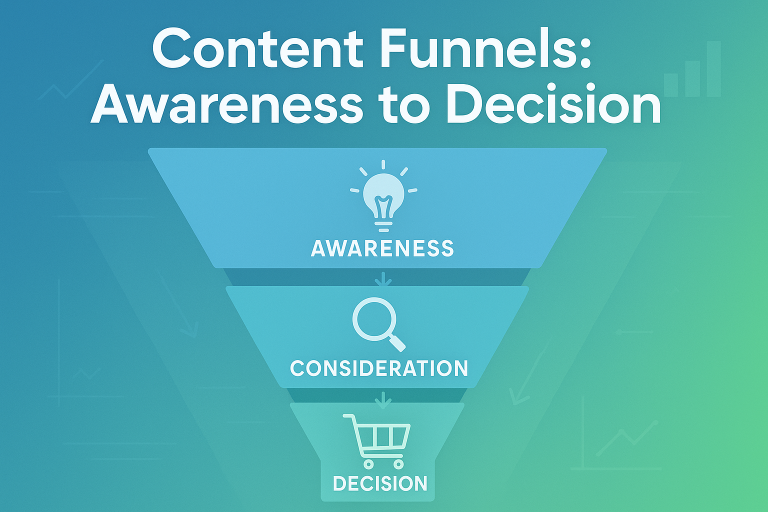
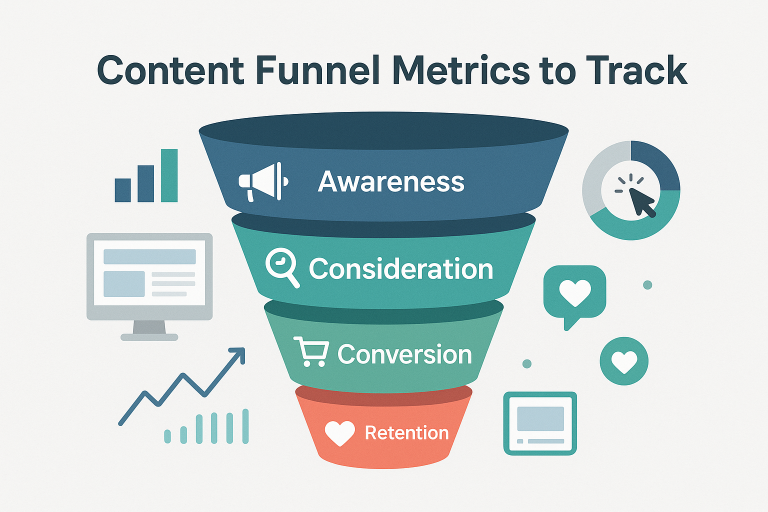
Modern content marketing funnels typically consist of four key stages, each with distinct objectives and content types. Understanding these stages is essential before examining specific examples.
1. Awareness Stage (TOFU – Top of Funnel)
At the awareness stage, prospects recognize they have a problem but don’t know your solution exists. Content here aims to educate and build brand visibility without selling.
User Intent: Information-seeking, problem identification, educational
Content Goals: Attract attention, establish expertise, provide value
Psychological Principle: Reciprocity – offering valuable information creates a sense of obligation
Key Metrics: Traffic, social shares, time on page, new visitors
2. Consideration Stage (MOFU – Middle of Funnel)
During consideration, prospects understand their problem and evaluate potential solutions. Content here should position your offering as the ideal solution while building trust.
User Intent: Solution exploration, comparison, evaluation
Content Goals: Nurture interest, demonstrate expertise, establish trust
Psychological Principle: Authority – showcasing expertise builds credibility
Key Metrics: Email sign-ups, content downloads, return visits, engagement time
3. Decision Stage (BOFU – Bottom of Funnel)
At the decision stage, prospects are ready to purchase but need final validation. Content here removes purchasing barriers and facilitates conversion.
User Intent: Verification, justification, purchase preparation
Content Goals: Overcome objections, demonstrate value, encourage action
Psychological Principle: Social proof – showing others’ success reduces purchase anxiety
Key Metrics: Conversion rate, sales, demo requests, trials started
4. Retention Stage (Post-Purchase)
The retention stage focuses on maximizing customer value through continued engagement. Content here enhances product usage and encourages advocacy.
User Intent: Implementation, optimization, problem-solving
Content Goals: Support product usage, drive additional value, encourage referrals
Psychological Principle: Consistency – people tend to remain consistent with prior commitments
Key Metrics: Customer lifetime value, renewal rates, satisfaction scores, referrals
With a clear understanding of each funnel stage, let’s explore real-world examples of content that effectively serves each stage across different business types and industries.
Top-of-Funnel Content Examples (Awareness Stage)
The awareness stage is where prospects first discover your brand. These top-of-funnel content examples excel at attracting new audiences and establishing initial engagement without aggressive selling.
HubSpot’s Comprehensive Resource Guides

Company/Industry: HubSpot / Marketing Software
Content Format: Long-form blog posts and downloadable guides
Why It Works: HubSpot’s “Ultimate Guide to Marketing Automation” spans over 5,000 words and covers everything from basic definitions to advanced strategies. It succeeds by answering fundamental questions without pushing their product. The company reports these comprehensive guides generate 3-4x more traffic than average blog posts and rank for hundreds of keywords.
Psychological Appeal: Establishes HubSpot as an authoritative source while creating value before asking for anything in return.
Wistia’s Explanatory Video Series

Company/Industry: Wistia / Video Hosting Platform
Content Format: Educational video series
Why It Works: Wistia’s “One, Ten, One Hundred” video series explores video production at three vastly different budget levels. The documentary-style content attracts filmmakers, marketers, and businesses interested in video without explicitly selling Wistia’s platform. The series generated over 100,000 views and significantly increased brand awareness among their target audience.
Psychological Appeal: Creates curiosity and provides genuine entertainment value while subtly demonstrating Wistia’s expertise.
Venngage’s Data Visualizations

Company/Industry: Venngage / Infographic Creator
Content Format: Infographics and data visualizations
Why It Works: Venngage’s “Visual Content Marketing Statistics” infographic compiles data from multiple sources into an easily digestible visual format. It attracts marketers seeking data to justify visual content investments. One of their infographics generated over 6,000 social shares and drove a 40% increase in new site visitors.
Psychological Appeal: Delivers value through data compilation while visually demonstrating what users can create with their tool.
Buffer’s Educational Social Media Posts

Company/Industry: Buffer / Social Media Management
Content Format: Educational social media content
Why It Works: Buffer creates bite-sized social media tips and statistics that solve immediate problems for social media managers. Their carousel posts on Instagram regularly receive 10x higher engagement than promotional content. Each post stands alone as valuable while establishing Buffer’s expertise in social media management.
Psychological Appeal: Provides immediate gratification through quick tips while building familiarity with the brand.
While these awareness-stage examples excel at attracting attention, middle-of-funnel content is needed to nurture that initial interest into deeper engagement. Let’s examine how different brands accomplish this.
Middle-of-Funnel Content Examples (Consideration Stage)
The consideration stage is where prospects evaluate solutions to their problems. These middle-of-funnel content examples excel at building credibility, demonstrating expertise, and helping users compare options.
SEMrush’s Tactical Webinars

Company/Industry: SEMrush / SEO and Digital Marketing Platform
Content Format: Live and recorded webinars
Why It Works: SEMrush’s “Competitive Analysis Masterclass” webinar series provides actionable tactics for analyzing competitors using their platform. By requiring registration, they capture leads while delivering specialized knowledge. Their webinars average 2,000+ registrants with a 40% attendance rate and 65% lead-to-demo conversion rate.
Psychological Appeal: Creates FOMO (fear of missing out) through limited-time events while demonstrating real-world application of their tools.
Ahrefs’ Comprehensive Tutorials

Company/Industry: Ahrefs / SEO Tools
Content Format: Step-by-step written and video tutorials
Why It Works: Ahrefs’ “Keyword Research: The Definitive Guide” provides exhaustive instruction on this critical SEO task while naturally showcasing their tool’s capabilities. The guide maintains educational value while helping prospects visualize how the platform solves their specific problems. This guide generates approximately 10,000 monthly visits and ranks #1 for several high-value keywords.
Psychological Appeal: Builds perceived ownership by allowing users to imagine themselves using the tool successfully.
Wirecutter’s Product Comparisons

Company/Industry: Wirecutter (New York Times) / Product Review Site
Content Format: In-depth comparison articles
Why It Works: Wirecutter’s “The Best Air Purifiers” comparison evaluates multiple products across standardized criteria, establishing trust through transparent methodology. By addressing common concerns like cost, noise, and maintenance, they help consumers narrow options. Their comparison articles have conversion rates 3-4x higher than standard reviews.
Psychological Appeal: Reduces decision paralysis by providing clear frameworks for evaluation.
Salesforce Customer Stories

Company/Industry: Salesforce / CRM Platform
Content Format: Written and video case studies
Why It Works: Salesforce’s case study of Adidas shows how the sportswear giant used their platform to increase e-commerce sales by 35%. By showcasing recognizable brands and including specific metrics, they build credibility while helping prospects see relevant applications. Their case studies generate 25% higher engagement time than other content types.
Psychological Appeal: Leverages social proof through association with successful, recognizable brands.
As prospects move closer to making a decision, they need more specific information to justify their choice. Let’s examine bottom-of-funnel content examples that effectively drive conversions.
Bottom-of-Funnel Content Examples (Decision Stage)
The decision stage is where prospects are ready to convert. These bottom-of-funnel content examples excel at addressing final objections, providing proof, and facilitating action.
Zoom’s Interactive Product Tours

Company/Industry: Zoom / Video Conferencing
Content Format: Interactive product demonstrations
Why It Works: Zoom’s guided product tour walks prospects through key features like meeting setup, recording, and security settings. By allowing hands-on interaction before purchase, they reduce perceived risk. Their product tours increase trial sign-ups by 28% compared to static feature pages.
Psychological Appeal: Creates familiarity with the interface, reducing fear of the unknown.
G2’s User Review Collections

Company/Industry: G2 / Software Review Platform
Content Format: Verified user reviews and ratings
Why It Works: G2 collects and displays thousands of verified user reviews across software categories. Companies like Monday.com showcase these reviews to build trust through authentic user testimonials, addressing specific use cases and concerns. Companies featuring G2 badges on landing pages see conversion increases of 25-40%.
Psychological Appeal: Leverages the bandwagon effect – people tend to follow others’ actions.
Adobe’s Free Trial Content

Company/Industry: Adobe / Creative Software
Content Format: Trial-specific resources and tutorials
Why It Works: Adobe’s Creative Cloud trial comes with targeted onboarding content that helps users experience quick wins. Their “First Project” series guides new users to create something meaningful during the trial period. This approach has increased trial-to-purchase conversion by 15% by ensuring users see immediate value.
Psychological Appeal: Creates investment through usage, making it harder to abandon the product.
Zendesk’s Interactive Pricing Pages

Company/Industry: Zendesk / Customer Service Software
Content Format: Interactive pricing calculator
Why It Works: Zendesk’s pricing page allows prospects to select features, agent count, and service levels to see customized pricing. By including feature comparisons and ROI calculations, they address budget concerns directly. Their interactive pricing pages increase qualified lead submissions by 35% compared to static pricing.
Psychological Appeal: Gives users control over the buying process, reducing resistance.
While many companies focus exclusively on pre-purchase content, the most effective content funnels continue engaging customers post-purchase. Let’s examine examples of retention-focused content.
Post-Purchase Content Examples (Retention Stage)
The retention stage is often overlooked but critical for maximizing customer lifetime value. These post-purchase content examples excel at enhancing customer experience, encouraging repeat business, and fostering advocacy.
Slack’s User Onboarding Sequence

Company/Industry: Slack / Team Communication Platform
Content Format: In-app tutorials and email sequence
Why It Works: Slack’s onboarding delivers contextual guidance based on user behavior, celebrating milestones like sending first messages or creating channels. Their interactive tutorials guide users through advanced features at appropriate times. This approach has increased new team activation by 50% and reduced churn by 33%.
Psychological Appeal: Creates habit formation through guided repetition and positive reinforcement.
Notion’s Product Update Newsletters

Company/Industry: Notion / Productivity Platform
Content Format: Email newsletters and release notes
Why It Works: Notion’s “What’s New” updates highlight feature improvements with specific use cases and tutorial videos. By focusing on user problems solved rather than technical changes, they drive feature adoption. Their update emails have 2-3x higher open rates than industry averages and drive significant feature engagement.
Psychological Appeal: Creates ongoing discovery, preventing feature fatigue and platform abandonment.
Canva’s Design School

Company/Industry: Canva / Graphic Design Platform
Content Format: Educational hub with courses and tutorials
Why It Works: Canva Design School offers free courses that help users improve their design skills while mastering the platform. By teaching principles beyond basic tool usage, they increase user capability and satisfaction. Users who complete courses create 3.4x more designs and have 78% higher retention rates.
Psychological Appeal: Creates mastery motivation by helping users continuously improve their skills.
Peloton’s Community Content

Company/Industry: Peloton / Fitness Equipment and Content
Content Format: User-generated content and challenges
Why It Works: Peloton cultivates community through challenges, leaderboards, and hashtag campaigns that encourage users to share achievements. By facilitating connections between users, they create social accountability and belonging. Members who participate in challenges have 87% higher 12-month retention rates than non-participants.
Psychological Appeal: Leverages social connection to create emotional investment beyond the product itself.
Now that we’ve examined examples for each stage, let’s look at how organizations can create cohesive multi-stage content funnels that work together as a unified system.
Multi-Stage Content Funnel Examples (End-to-End Campaigns)
The most effective content marketing happens when pieces work together across funnel stages. These examples showcase integrated content funnels that guide users from awareness through retention.
HubSpot’s Integrated Resource Center

Company/Industry: HubSpot / Marketing and Sales Software
Campaign Overview: HubSpot’s comprehensive content ecosystem connects blog posts, guides, courses, certification programs, and user communities.
Funnel Integration:
- Awareness: SEO-optimized blog posts and free tools (Website Grader, Email Signature Generator)
- Consideration: Downloadable reports requiring email signup, webinars, and product comparison guides
- Decision: Free certification courses demonstrating platform capabilities, case studies, and ROI calculators
- Retention: Academy courses for advanced users, community forums, and user conferences
Results: This integrated approach generates over 7 million monthly visitors, with conversion rates from visitor to customer 3x higher than industry averages. Users who engage with multiple content types have 32% higher lifetime value.
Success Factors: Consistent messaging across formats, clear pathways between content pieces, and strategic gating of high-value content.
Glossier’s Community-Driven Content Strategy

Company/Industry: Glossier / Beauty Products
Campaign Overview: Glossier built a beauty brand through content-first strategy, starting with their Into The Gloss blog before launching products.
Funnel Integration:
- Awareness: Editorial beauty content and trends coverage on Into The Gloss
- Consideration: User-generated reviews, “Top Shelf” interviews with influencers, and tutorial content
- Decision: Before/after photos, ingredient education, and transparent product development
- Retention: #glossiergirl feature campaigns, limited edition launches, and insider previews
Results: Built a $1.2 billion valuation with 80% of growth coming through owned channels and earned media rather than paid advertising. Their repeat purchase rate is 2x industry average.
Success Factors: Content that feels authentic rather than promotional, strong feedback loops between customers and product development, and creating a sense of belonging.
Ahrefs’ Small Team Content Funnel

Company/Industry: Ahrefs / SEO Tools
Campaign Overview: Despite a small marketing team, Ahrefs built a comprehensive content funnel focused on quality over quantity.
Funnel Integration:
- Awareness: Data-driven studies and keyword-focused blog content
- Consideration: Detailed tutorials showing product capabilities, YouTube channel with specific use cases
- Decision: Comparison content, free tools demonstrating value, and transparent pricing
- Retention: Product webinars, feature announcements with use cases, and advanced tactics
Results: Achieved 30%+ year-over-year growth with minimal paid advertising. Their content generates over 500,000 monthly organic visits and maintains industry-leading retention rates.
Success Factors: Deep understanding of user problems, consistent publishing of high-quality content, and clear demonstration of product value.
These integrated examples demonstrate the power of systematic content development. Next, let’s examine how to create personalized content experiences that adapt to individual user needs at each funnel stage.
Personalized Content Funnel Examples (Adaptive Experiences)
Modern content funnels increasingly use personalization to deliver relevant experiences. These examples showcase how brands tailor content to individual preferences, behaviors, and needs at each funnel stage.
Netflix’s Recommendation Engine

Company/Industry: Netflix / Streaming Entertainment
Personalization Approach: Algorithmic content recommendations based on viewing history, browsing behavior, and similar user patterns
How It Works: Netflix personalizes not just recommendations but also thumbnails, trailers, and category organization. Their system analyzes over 30 million daily viewing sessions to identify patterns. A viewer who watches action movies might see action-oriented thumbnails for shows that contain multiple genres.
Results: This personalization reportedly saves Netflix $1 billion annually through retention and generates 80% of content discovery on the platform. Users typically consider only 10-20 titles before making a selection.
I’ve implemented similar personalization techniques for clients, starting with basic segments and gradually adding complexity based on user behavior. The key is collecting the right data points without overwhelming your systems.
Grammarly’s Engagement Reports

Company/Industry: Grammarly / Writing Assistant
Personalization Approach: Behavioral trigger content based on user writing patterns
How It Works: Grammarly sends weekly personalized reports showing writing statistics, improvement areas, and vocabulary patterns unique to each user. The content adapts based on writing volume, common errors, and engagement with previous reports. Premium feature recommendations align with individual writing challenges.
Results: These personalized reports achieve open rates above 50% and have increased premium conversions by 25%. Users who engage with weekly reports have retention rates 40% higher than non-engaged users.
Adobe’s Industry-Specific Journeys

Company/Industry: Adobe / Creative and Marketing Software
Personalization Approach: Segment-based content paths organized by industry and role
How It Works: Adobe segments visitors based on initial content consumption and declared interests, then delivers industry-specific case studies, tutorials, and feature highlights. A photographer sees different content than a video editor, even though both might use the same product suite. Their system progressively builds profiles based on engagement.
Results: This approach has increased engagement by 33% and improved conversion rates by 28%. Users in personalized journeys consume 3.7x more content before purchase decisions.
While these examples demonstrate what’s possible, creating an effective content funnel requires a systematic approach. Let’s examine how to build your own content funnel strategy.
How to Build Your Own Content Marketing Funnel (Step-by-Step)
Creating an effective content funnel isn’t about copying examples, but rather understanding the principles behind successful implementations. Follow this step-by-step process to develop a content funnel tailored to your specific business needs.
Step 1: Define Audience Personas and Journey Stages
Start by creating detailed profiles of your target audiences and mapping their journey:
- Identify 2-3 primary audience segments based on goals, challenges, and information needs
- Document specific questions they ask at each funnel stage
- Map existing customer journeys to identify common paths and friction points
Tool: Create simple persona templates with demographic info, goals, challenges, and preferred content formats
Common Mistake: Creating too many personas that dilute focus. Start with your most valuable segments.
Step 2: Map Content Needs to Each Stage
Develop a content matrix that aligns with funnel stages:
- List specific content topics that address questions from Step 1
- Assign appropriate formats for each topic (blog, video, guide, etc.)
- Identify primary distribution channels for each content piece
- Define clear purpose and call-to-action for each item
Tool: Content mapping spreadsheet with columns for funnel stage, topic, format, channel, and CTA
Common Mistake: Focusing too heavily on one funnel stage. Many companies overinvest in awareness content while neglecting decision and retention stages.
Step 3: Audit Existing Content and Identify Gaps
Evaluate your current content assets against your map:
- Inventory all existing content and categorize by funnel stage
- Assess performance using relevant metrics for each stage
- Identify content gaps and opportunities for repurposing
- Prioritize new content creation based on strategic value
Tool: Content audit template with performance metrics and gap analysis
Common Mistake: Starting from scratch when you likely have valuable content that can be updated or repurposed.
Step 4: Develop Content Briefs for Missing Pieces
Create detailed plans for content creation:
- Write comprehensive briefs for each content piece
- Include target keywords, goal metrics, and specific CTAs
- Define success metrics based on funnel position
- Identify internal and external sources for credibility
Tool: Standardized brief template with sections for objectives, audience, keywords, and structure
Common Mistake: Vague briefs that lead to content misaligned with strategic objectives.
Step 5: Create Content with Conversion Pathways
Develop content with clear next steps:
- Build logical connections between related content pieces
- Include appropriate calls-to-action based on funnel stage
- Design content for both consumption and conversion
- Create content upgrades that capture leads naturally
Tool: CTA library with options for each funnel stage
Common Mistake: Creating dead-end content without clear next steps for the reader.
Step 6: Implement Distribution and Promotion
Develop channel-specific promotion strategies:
- Create channel-optimized versions of each content piece
- Develop promotion calendars with multiple touchpoints
- Leverage paid amplification for high-value content
- Implement internal linking strategies for SEO benefit
Tool: Channel distribution matrix with format specifications for each platform
Common Mistake: The “publish and pray” approach without strategic promotion. Many companies make the mistake of underinvesting in content distribution, which severely limits content ROI.
Step 7: Measure and Optimize Performance
Implement continuous improvement cycles:
- Track stage-appropriate metrics for each content piece
- Analyze content effectiveness at moving users through funnel
- Identify high-performing content elements to replicate
- Regularly update and improve underperforming content
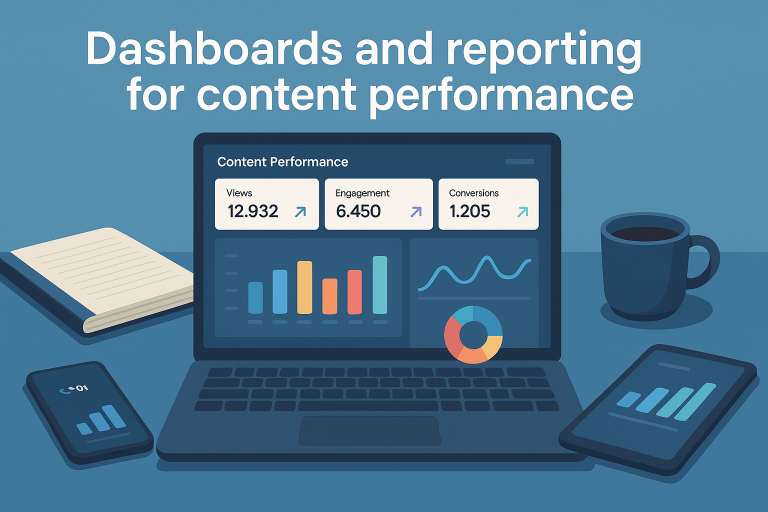
Tool: Content performance dashboard with funnel conversion metrics
Common Mistake: Using the same metrics for all content instead of stage-appropriate KPIs.
With your content funnel strategy in place, you’ll need to measure its effectiveness. Let’s examine the key metrics and KPIs for evaluating content funnel performance.
Measuring Content Funnel Success (Key Metrics & KPIs)
A well-structured content funnel should drive measurable business results. Here’s how to establish the right metrics for each funnel stage and evaluate overall performance.
Awareness Stage Metrics
Focus on reach and initial engagement:
- Organic traffic: New users from search engines
- Social engagement: Shares, comments, and reactions
- Brand search volume: People searching for your brand name
- Referral traffic: Visitors from other websites
- Impression share: Visibility for target keywords
Benchmark: The average blog post generates 1,100 social shares, but top performers reach 5,000+. Industry-specific benchmarks vary widely.
Visualization: Traffic source trends and topic performance dashboards
Consideration Stage Metrics
Measure deepening engagement:
- Return visitor rate: Percentage of visitors who come back
- Content downloads: Resource acquisition volume
- Email sign-ups: Newsletter and lead magnet conversions
- Time on site: Engagement duration
- Pages per session: Content consumption depth
Benchmark: Average email opt-in rates range from 1-5%, with high-performing pages achieving 10%+. Resource downloads typically convert at 2-8% depending on value perception.
Visualization: Engagement funnel showing progression from awareness to consideration
Decision Stage Metrics
Track conversion activity:
- Demo/trial requests: Product interest actions
- Sales qualified leads (SQLs): Prospects ready for sales contact
- Conversion rate: Percentage completing desired actions
- Content attribution: Revenue influenced by specific content
- Quote requests: Direct purchase interest indicators
Benchmark: Average B2B conversion rates from lead to opportunity range from 10-15%, while e-commerce product page conversion rates average 2-3%.
Visualization: Content-attributed pipeline and revenue dashboards
Retention Stage Metrics
Evaluate ongoing relationship quality:
- Customer lifetime value (CLV): Total customer revenue over time
- Net Promoter Score (NPS): Customer satisfaction and loyalty
- Churn rate: Customer retention percentage
- Repeat purchase rate: Frequency of additional purchases
- Referral rate: New customers from existing customer recommendations
Benchmark: Companies with strong content-led retention programs see 20-40% higher customer lifetime value than those without systematic post-purchase content.
Visualization: Customer cohort analysis showing retention patterns
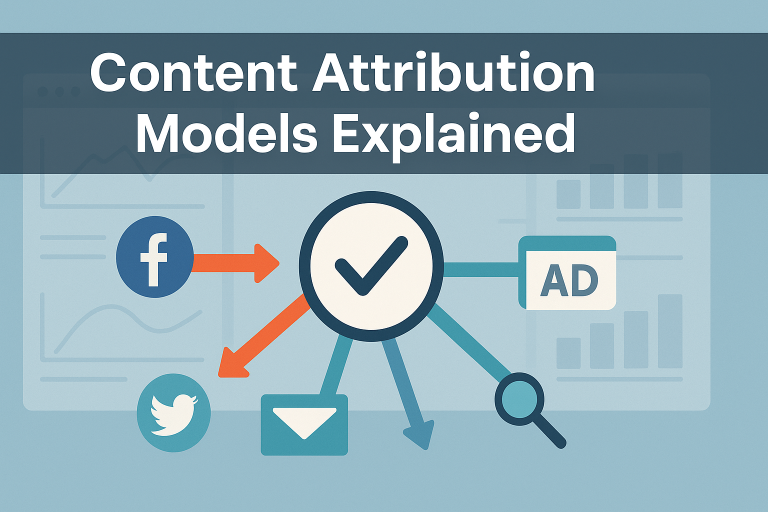
Attribution Modeling Approaches
To understand content contribution across the funnel:
- First-touch attribution: Credits initial content interaction
- Last-touch attribution: Credits final content before conversion
- Linear attribution: Distributes credit evenly across touchpoints
- Position-based attribution: Emphasizes first and last interactions
- Data-driven attribution: Uses algorithms to determine content impact
Tool Recommendation: Google Analytics 4 provides built-in attribution modeling with path exploration
Understanding these measurement frameworks allows you to continuously improve your content funnel. Now, let’s address common challenges and how to overcome them.
Common Content Funnel Challenges (And How to Solve Them)
Even well-designed content funnels face obstacles. Here are the most common challenges content marketers encounter and proven solutions based on successful examples.
Challenge 1: Limited Resources for Content Creation
Problem: Insufficient budget or team capacity to create enough content for a complete funnel.
Solution: Content Atomization
- Create cornerstone pieces that can be broken into multiple formats
- Repurpose single pieces of content across multiple channels
- Focus on quality over quantity at each funnel stage
Example: Buffer creates comprehensive guides that they then break into blog posts, social media updates, email series, and webinars. This approach generates 4-5x more content from a single research investment.
Challenge 2: Content Distribution Bottlenecks
Problem: Creating content but failing to reach target audiences effectively.
Solution: Multi-Channel Repurposing
- Adapt core content to channel-specific formats
- Develop distribution templates for consistent promotion
- Partner with relevant communities and influencers
Example: Ahrefs transforms each blog post into YouTube videos, Twitter threads, and LinkedIn carousels. This multi-channel approach has expanded their audience reach by 300% with minimal additional content creation.
Challenge 3: Low Conversion Between Funnel Stages
Problem: Users consume content but don’t progress to the next funnel stage.
Solution: Stronger CTAs and Content Pathways
- Create explicit content journeys with clear next steps
- Use content upgrades specific to each piece
- Implement strategic internal linking between related content
Example: HubSpot includes stage-appropriate CTAs in every piece of content. Their blog posts for beginners link to comprehensive guides, while advanced content links to product demonstrations. This approach has increased their content-to-lead conversion by 45%.
Challenge 4: Measuring Content ROI
Problem: Difficulty connecting content investments to revenue outcomes.
Solution: Multi-Touch Attribution Modeling
- Implement content tagging for consistent tracking
- Develop stage-appropriate metrics for each content piece
- Create content-specific conversion paths
Example: Wistia implemented UTM parameter standardization and multi-touch attribution to track content influence across the customer journey. This approach revealed that customers engaging with their blog converted 25% faster and had 40% higher lifetime value.
Challenge 5: Sales-Marketing Alignment
Problem: Disconnect between content marketing efforts and sales team needs.
Solution: Shared Metrics and Collaboration
- Create content based on actual sales conversations
- Develop sales enablement materials alongside marketing content
- Establish regular feedback loops between teams
Example: DocuSign created a shared Slack channel where sales teams submit prospect questions that marketing then addresses through content. This process increased sales team content usage by 85% and improved close rates on content-nurtured leads by 32%.
By addressing these common challenges, you can create a more effective content funnel. Let’s conclude with emerging trends shaping the future of content funnels.
Future Trends in Content Marketing Funnels (What’s Next)
Content marketing funnels continue to evolve with changing technology and consumer behavior. These emerging trends will shape how brands develop content funnels in the coming years.
AI-Generated and AI-Enhanced Content
AI tools are revolutionizing content creation and personalization:
- Automated content generation for data-driven pieces
- AI-powered personalization at scale
- Predictive content recommendations based on behavior
Early Adopters: Jasper AI partners with brands to create first-draft content that human editors refine. The Washington Post uses Heliograf to generate data-driven stories like financial reports and sports recaps.
Implementation Consideration: Focus on using AI for content enhancement and scaling rather than replacement of human creativity. The best results come from human-AI collaboration.
Voice and Conversational Content
Voice-optimized content is becoming essential as conversational interfaces grow:
- Question-based content structures for voice search
- Interactive voice experiences for hands-free learning
- Conversational content formats for chatbots and assistants
Early Adopters: Mayo Clinic optimizes health content for voice search, answering common questions in conversational format. Sephora’s chatbot funnels combine content and commerce in interactive dialogues.
Implementation Consideration: Restructure key content in question-answer format and focus on featured snippet optimization for voice search visibility.
Zero/First-Party Data Strategies
As third-party cookies disappear, content funnels are shifting to owned data:
- Value-exchange content that encourages data sharing
- Progressive profiling through content interactions
- Cookieless personalization techniques
Early Adopters: The New York Times uses first-party data from content preferences to create highly targeted advertising opportunities. Starbucks collects zero-party preference data through their app to deliver personalized content and offers.
Implementation Consideration: Develop valuable content experiences that make data sharing worthwhile for users while being transparent about usage.
Community-Led Content Approaches
Content funnels are incorporating community elements for deeper engagement:
- User-generated content integration into marketing funnels
- Community-driven topic selection and feedback
- Collaborative content creation with customers
Early Adopters: Glossier incorporates customer feedback and stories throughout their content funnel. Notion encourages users to share templates and workflows that feed back into their marketing.
Implementation Consideration: Create structured opportunities for community contribution while maintaining quality standards and brand alignment.
Immersive Content Experiences
Interactive and immersive formats are creating deeper engagement:
- Augmented reality product experiences
- Interactive assessments and calculators
- Virtual spaces for content exploration
Early Adopters: IKEA’s AR app lets customers visualize furniture in their homes before purchase. HubSpot’s Website Grader creates personalized assessment reports that feed into their content funnel.
Implementation Consideration: Start with simple interactive elements that add genuine value rather than pursuing immersive technology for its own sake.
By understanding these trends while mastering the fundamentals, you can develop content funnels that not only convert today’s customers but position your brand for future success.
Conclusion: Building Your Content Funnel Strategy
An effective content marketing funnel aligns valuable content with each stage of the customer journey, guiding prospects from awareness to advocacy in a natural, helpful way.
The examples we’ve explored demonstrate that successful content funnels share several key characteristics: they address specific user needs at each stage, maintain consistent quality across touchpoints, create clear pathways between pieces, and evolve based on performance data.
Your content funnel strategy should be tailored to your specific business objectives, audience needs, and resource constraints. Rather than attempting to implement everything at once, start by mapping your current content to funnel stages, identifying the most critical gaps, and creating a focused plan to address them.
Remember that content marketing is a long-term investment. The most successful funnels I’ve helped build took months to fully implement but delivered consistent returns for years afterward. The key is starting with clear objectives and measuring progress consistently.
Begin by selecting one example from this guide that aligns with your most pressing business need, adapt it to your context, and measure the results. Then gradually expand your content funnel based on what works best for your specific audience.